

• No products in the cart.

An Arduino Board is not a Microcontroller

ARDUINO BOARDS:

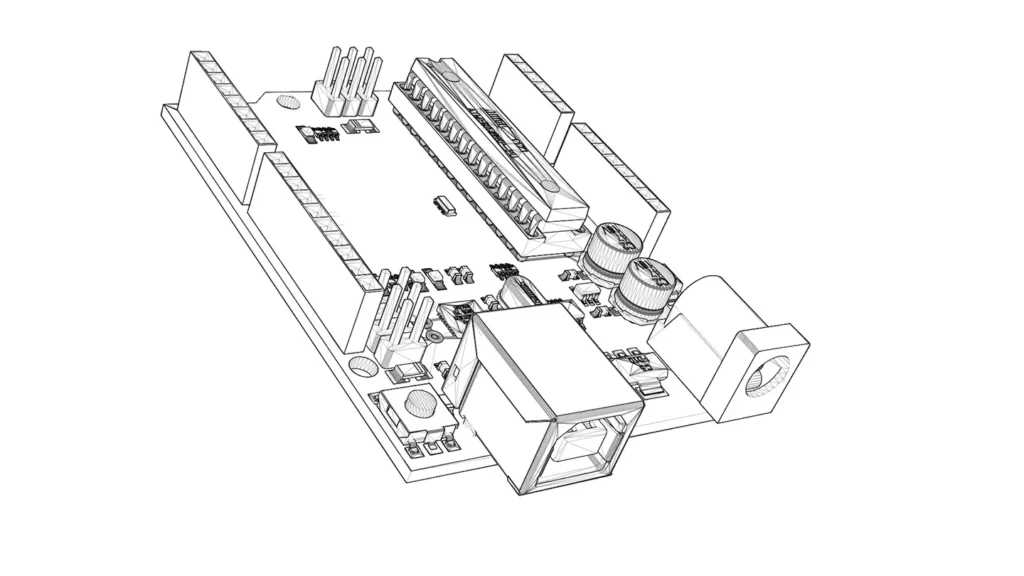
Arduino boards are open-source, electronic circuit boards designed around microcontrollers.

  • open-source: Open-source refers to software or hardware whose design is made publicly available for anyone to view, use, modify, and distribute. 
  • circuit board: A thin board that holds and connects all the different parts needed to make the device work.
  • microcontrollers: Tiny computers on a single chip that can be programmed to control things like lights, motors, and sensors.
ACCESSIBLE

This Arduino platform makes electronics more accessible, distinguishing itself from traditional prototyping tools, which Hernando Barragán describes as “mostly targeted to engineering, robotics, and technical audiences” and “hard to learn.”

By simplifying both the hardware and software, Arduino provides a more approachable entry point for a broad range of tasks and projects. This accessibility extends its usefulness beyond specific technological contexts, making it ideal for educators, hobbyists, and students without a deep background in engineering.

PURPOSE AND USE

Arduino is widely used in Interactive Art, Electronic Art , education, prototyping, and DIY projects due to its ease of use. It builds on the foundations of the "Processing" language, designed primarily for crafting visuals on computer screens and, more importantly, the "Wiring" language, to provide a simple integrated development environment (IDE) and a programming framework based on C/C++.

This simplifies the programming of the microcontroller , making Arduino particularly accessible for those new to electronics and programming.


Prototyping with Arduino

Prototyping is an essential step in the process of creating new products or systems. It involves making a preliminary model, or a "prototype" to test and refine ideas before final production.

Arduino is particularly popular for prototyping for several reasons:

Accessibility

Arduino boards are user-friendly, making them accessible to both beginners and professionals. They don’t require advanced knowledge in electronics to get started, which lowers the barrier for entry into prototyping.

Flexibility

With Arduino, you can connect a wide variety of sensors and actuators easily, allowing for a broad range of functionality — from simple devices like temperature sensors to more complex systems like robots or smart home devices.
Open Source

Arduino is open source, which means its designs are publicly accessible. Users can modify and improve their prototypes without restrictions, benefitting from a vast community of developers and hobbyists who share their knowledge and code.

Cost-Effective

Arduino boards are relatively inexpensive, which makes them ideal for testing out new ideas without a significant financial investment. This cost-effectiveness is particularly appealing in the early stages of design, where multiple iterations may be necessary.

Arduino allows creators, artists, and engineers to bring their ideas to life quickly and efficiently. This capability makes it an invaluable tool in the world of digital art and design, where experimentation and iteration are key to innovation. Whether it's for creating a piece of interactive art or developing a new electronic gadget, Arduino provides the necessary tools to build, test, and refine ideas in a tangible form.
MICROCONTROLLER

The key component on the board.

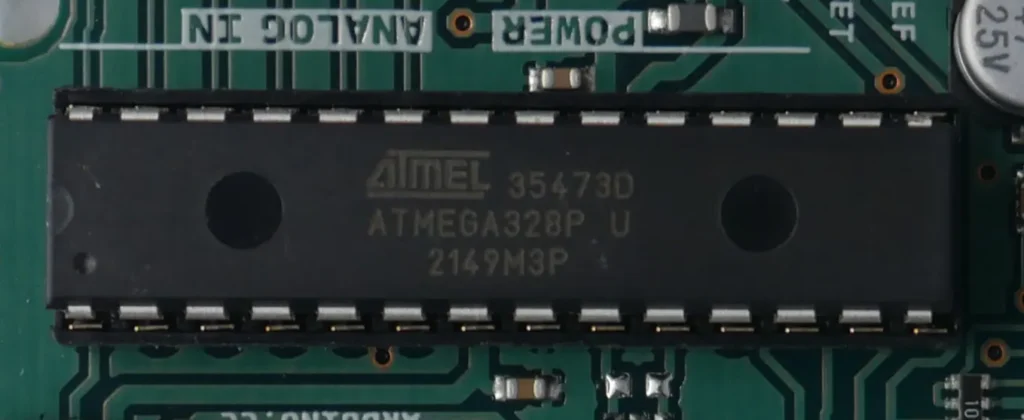
Each Arduino board typically includes a microcontroller chip (most commonly from the AVR family, like the ATmega328 for the Arduino Uno), and standard connectors that expose the micro-controller's input/output (I/O) interfaces (pins) to other components and circuits.
ATmega328 Micro-Controller
ATmega328 Microcontroller
Arduino Uno Rev 3
Arduino Uno R3

Microcontroller

A microcontroller is a compact integrated circuit designed to govern specific operations in an embedded system. It includes a processor, memory, and programmable input/output peripherals.

Architecture

Microcontrollers are complete computing systems built onto a single chip. They are designed to perform specific tasks—such as reading sensor data, controlling motors, or operating home appliances—and can run only a single program stored in their memory.

Applications

Microcontrollers are found in countless everyday devices due to their efficiency and low cost. They are particularly useful in applications that require direct control of physical components and real-time responses.

Variants

Arduino boards utilize various microcontrollers to cater to different project needs, including ATmega328P in the UNO and Nano, ATmega2560 in the Mega, SAMD21 and ESP32 in the MKR series, and Renesas RA4M1 and RA4M2 in the UNO R4 models. Each microcontroller offers unique capabilities, making Arduino boards versatile tools for a wide range of applications.

Summary:

Arduino provides a user-friendly platform that includes a micro-controller, along with essential components and open-source software that makes it easier to program and integrate into various projects. It’s particularly favored for educational purposes and hobbyist projects.

Microcontrollers are versatile devices embedded within many of the electronics and gadgets around us. They are used in applications where low power consumption, space efficiency, and cost-effectiveness are crucial.


Welcome to VideotronicMaker

Welcome to VideotronicMaker.com

top
Site Design © tishin.site. All rights reserved.